Only Flying is a Pushcart-nominated collection of surreal free verse and prose poetry that celebrates transformation and paradox, exploring both the silence of the seeker and the outrageous wilderness of the imagination. Thematic threads like rebellion, enlightenment, risk, courage, love, loss, and triumph dance with pictures swinging from dark to light, surreal to whimsical, and strange to familiar. There are intimate goddesses here, black widows, buddhas, alley cats, a kangaroo, and magic pants—blacklight-blue Hendrix flares that hang from a fire escape, just waiting for the right person to jump up and steal them. That person is you.
I’m proud to share that my poem, “Ghazal for End Times, or, How to Stay Cozy in the Apocalypse,” has been published in South Broadway Press’s Autumn 2026 issue!
South Broadway Press informed contributors that the press received over 800 submissions to the four online editions this year. Only 45 poems were accepted, placing “Ghazal for End Times” in the top 2% of submissions. The poem took over a year to write, and I am grateful to the members of my writers’ group, The Nearby Universe, whose feedback was invaluable in revising it. Read it here: “Ghazal for End Times, or, How to Stay Cozy in the Apocalypse”
You can’t get far on the path to becoming a writer without being told to “kill your darlings.” There is value in the well-worn advice. It points to an author’s attachment to a character, sentence, or image, making it difficult to cut, even if it doesn’t serve the poem or story. Stephen King popularized the adage in his book On Writing: “Kill your darlings, kill your darlings, even when it breaks your egocentric little scribbler’s heart, kill your darlings.”
I don’t exactly disagree with this advice, but “kill” is the wrong word. The delete button is too blunt an instrument for something we wrote that we love for a reason: it’s catching, beautiful, ironic, or powerful. Something tells us we created something valuable, and that something is usually right. Then, we waste valuable time himming and hawing and glancing sideways at the delete button, because writers aren’t killers by nature, even when Stephen King tells them they are.
The right word is “relocate.” I tell my writing students to gently move their darlings to a comfortable, well-lit folder on their desks or computers. The benefit of this distinction is twofold: first, it becomes easier to remove the darling from the poem it doesn’t belong in, knowing we’re not losing it forever. Second, when the day comes that finds the writer at the table with nothing, as it always does sooner or later, we can suddenly remember our ace in the hole: the darlings folder. In there, the discarded gems shine even brighter, without context or competition. The image that didn’t fit in the story or poem it first appeared in could be the seed of a new thing all its own.
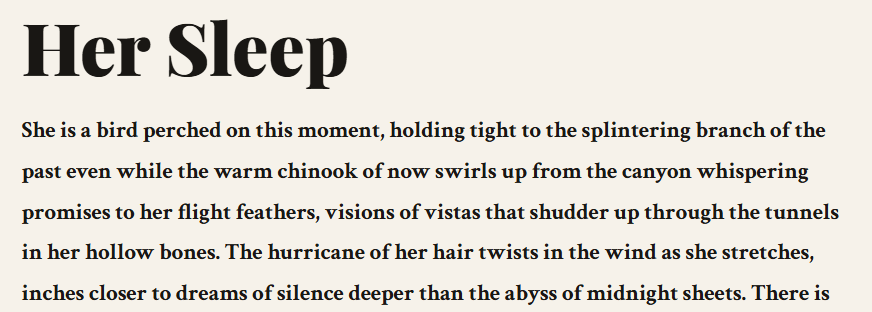
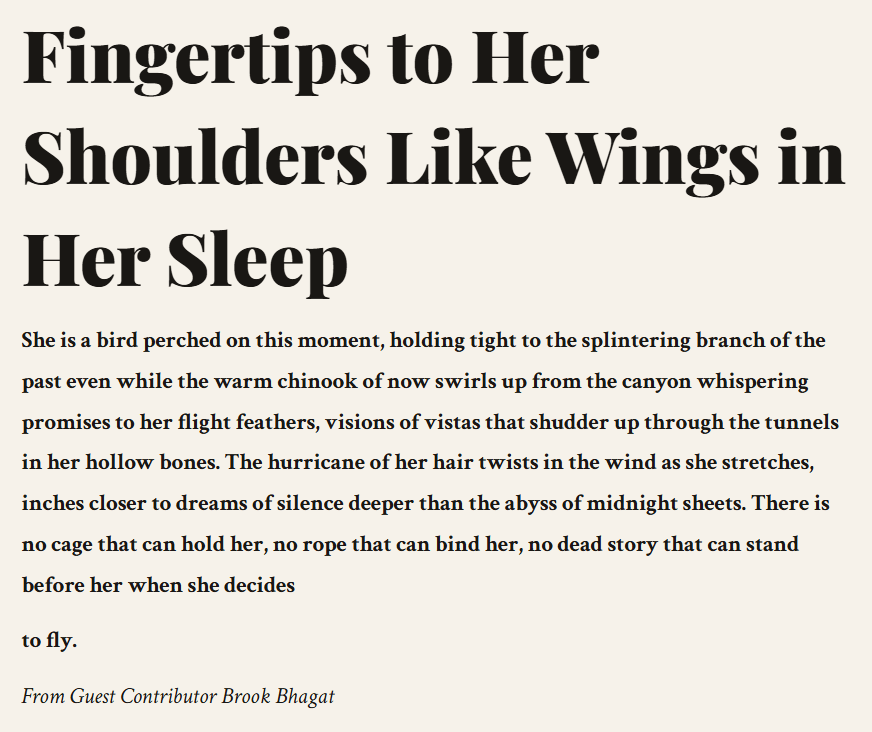
This is the origin story of my prose poem, “Fingertips to Her Shoulders Like Wings in Her Sleep,” which was recently published in A Story in 100 Words. The beauty of this darling haunted me, but there was nothing else I liked in the poem it was living in. Eventually, I gave up and relocated the image to the Darlings folder.
No less than two years later, when inspiration was thin one day, I pasted it into its own document. I looked deeply into it. Perhaps the woman is dreaming of what she might become, I thought. What might be holding her back? The image of wings stretched naturally into metaphors involving birds and flight, and I had a prose poem I was proud of in front of me in twenty minutes. Well, two years and twenty minutes, to be exact, but who’s counting?
I’m proud to share that Pikes Peak State College has awarded me a faculty sabbatical for fall 2026. Right now, and for a few more precious months, I am a full-time author working on two new books from Unsolicited Press: Exodus with Red Delicious, a collection of poetry and short fiction to be released in December 2026, and I Drink from an Ear: Real Ghazals, a collection forthcoming in December 2027.
Brook Bhagat, Assistant Professor of English at PPSC and author at Unsolicited Press
Exodus with Red Delicious explores death, grief, loss, and transformation from multiple angles, fictional, personal, and lyrical. While its creation was difficult emotionally, the work of writing it was an animal I was familiar with. The ghazal, however, is an entirely different beast.
The ghazal is an Eastern poetic form with roots in 7th-century Arabia. Its unusual formal constraints have made it notoriously difficult to write in English: my collection will join less than five verified single-author collections in existence.
There is an element to writing anything that is absolutely mysterious. The route to the most powerful poems is not recorded on any map. As poet-songwriter Leonard Cohen put it, “If I knew where the good songs came from, I’d go there more often.” Sometimes the lightning of inspiration strikes in a minute, or an hour; every writer knows it can also take much longer.
With ghazals, it has been a different journey than writing fiction or even other poetry. Ghazals need more time, more silence: they can circle for weeks in the sky before uttering a word. Having the luxury of emptiness has helped me make a space for them to land. Not emptiness exactly–there are still bills to pay and weeds to pull and children to pick up from play rehearsal. But not having essays to grade and textbooks to wrangle for a few months has created a small emptiness, a clear space where I am able to stand with my eyes closed for a while, waiting for ghazals.
Before the sabbatical began, I believed deeply in both of these books, in the transformative power of writing creatively, in the heart magic of teaching, and in the significance of the tradition of sabbatical leave in academia. Sabbatical leave provides teaching writers the most valuable gift in the world: time to write, which can mean time to wait for the mystery. A month in, I don’t know how I would have done it without it. Thank you, PPSC!
My gratitude also goes out to Unsolicited Press, especially my editor, Summer Stewart, who’s investing in me, too: believing in me so much she thinks even my future books are going to be good. Trusting me to catch falling ghazals. Reading my drafts carefully enough to know when I should have said John Lennon instead of the Beatles, and when I’m playing fast and loose with em-dashes–which is more often than I’d like to admit.
Finally, it’s worth noting that, on my sabbatical application, I requested to not be relieved of one special duty: facilitating the Nearby Universe, the PPSC employee creative writers’ group I founded almost nine years ago. This group continues to be an integral part of my writing community, and their feedback and support have undoubtedly made both my forthcoming books better. Thank you, Nearby Universe!
“Ghazal for J,” “Ghazal for the Outsider,” and “Ghazal for Unbraiding” were published in the first installment of the new summer community folio from Tempered Steel, the literary and arts journal of Colorado State University Pueblo. The journal is now accepting submissions from residents of El Paso and Pueblo counties, along with submissions from students. I am thrilled to see my words on the first page of this special project.
The folio includes an author’s note about the three poems: “I’m generally against rules, especially in poetry, and I wrote exclusively free verse for most of my life. Then, about two years ago, I tried writing ghazals, sticking to all the classic rules of the form. Something mystical happened: it was so tough that my poems had to take unexpected turns, turns that revealed strange images and truths I would never have found otherwise. I was in love. I never looked back, and now I’m working on a whole book of them.
“‘Ghazal for J’ is for one of my oldest and dearest friends. ‘Ghazal for the Outsider’ follows the Sufi tradition of addressing the Divine or Unknown in the second person, as the beloved. And in ‘Ghazal for Unbraiding,’ I imagine the self dissolving in different moments, different ways, like love or beauty or pain or meditation. Like a braid, coming loose.”
I’m proud to share that my creative nonfiction essay, “Making ‘Magic Chai,'” was published today on Ruadán Books‘ writing craft blog, Thoughts from the Writer’s Desk. The piece explores the story behind a story of grief and acceptance that I wrote three years ago, when my father was on hospice care. I’m so honored and grateful it found such a beautiful home. Read it here: Making “Magic Chai”